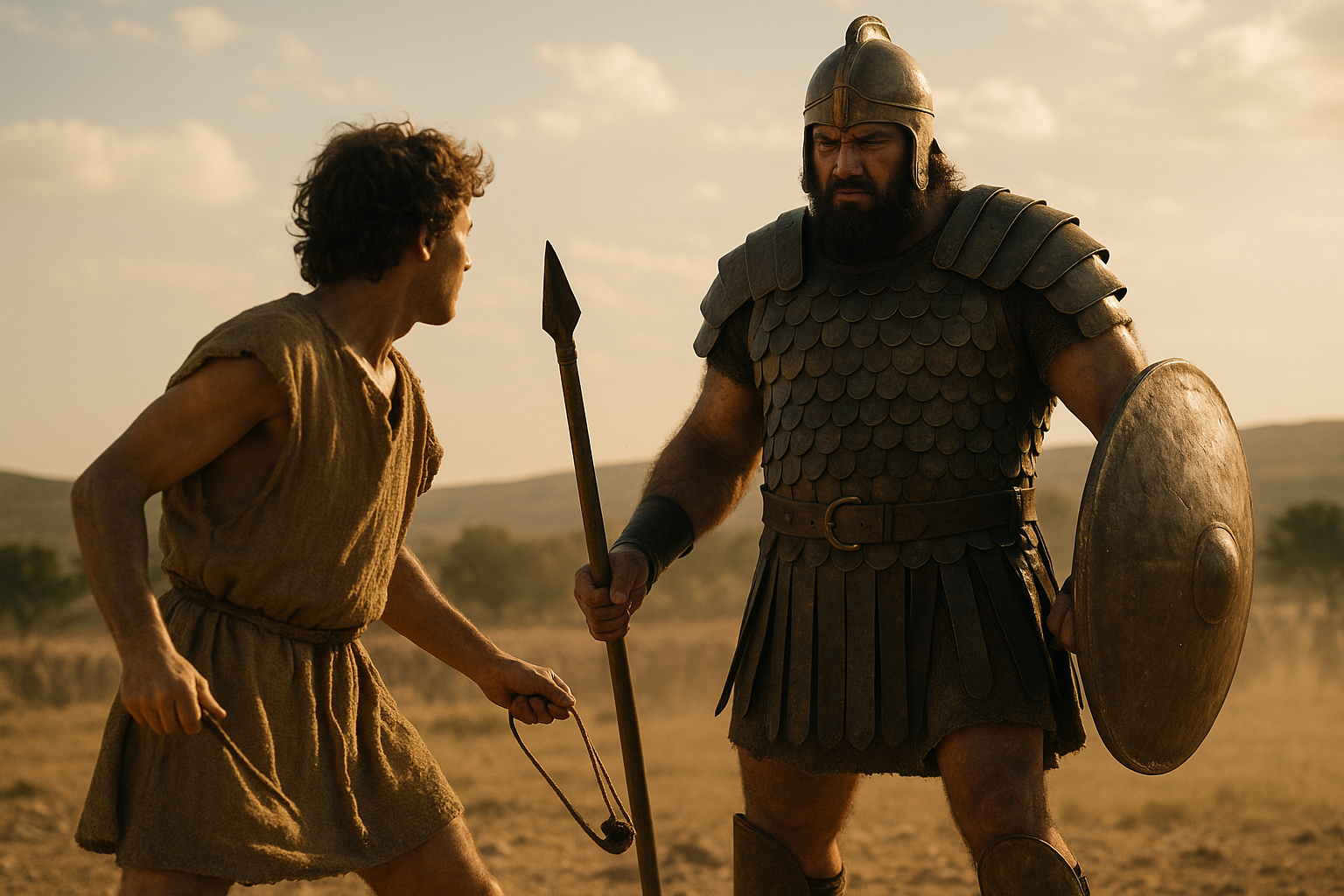
In the Valley of Elah, on a stifling day that foretold battle, two armies took their positions on opposing hills: on one side, the Philistines, skilled blacksmiths and feared warriors; on the other, the army of Israel, led by King Saul, who bore weeks of tension and dread upon his shoulders. Amid the Philistine ranks stood the colossal figure of Goliath of Gath, a warrior nearly ten feet tall, clad in gleaming bronze armor and bearing a spear with a shaft resembling an olive tree trunk. For forty consecutive mornings, he had strode to the front line, struck his chest, and challenged the Israelites, hurling insults and blasphemies against the God of Israel.
Goliath’s challenge was not mere mockery; he demanded single combat, declaring that the fate of both armies would hinge on the defeat of one champion. Whenever his thunderous voice rolled across the valley, Saul’s soldiers cowered behind their shields. The once-valiant king now averted his gaze from his officers, afraid that anyone might glimpse the terror that froze his veins. With each new dawn, the ritual of public humiliation drained the army’s morale.
It was then that David appeared—the youngest of Jesse’s eight sons—sent from Bethlehem solely to bring wheat, bread, and cheese to his brothers. Though youthful and unscarred by battle, he carried a secret record of courage: he had protected his father’s flock from lions and bears, engaging them with nothing but his sling and the faith he nurtured during long nights of watch. Upon arriving, David heard Goliath’s defiant roar echo among the hills and, shocked by the army’s passivity, asked why no one dared trust in God to silence the giant.
David’s bold questions traversed the camp until they reached King Saul, who ordered him summoned. Inside the royal tent—adorned with ornate spears and hastily drawn war maps—David spoke with unwavering confidence: “Let no one lose heart because of this Philistine; your servant will fight him.” Saul, incredulous, sought to dissuade him, citing his youth and Goliath’s formidable reputation. Undeterred, David recounted how he had delivered lambs from predators’ jaws and proclaimed, “The Lord who delivered me from the lion and the bear will deliver me from this Philistine’s hand.”
Impressed by the young man’s faith, Saul offered him his own armor—bronze helmet, heavy breastplate, long sword—artifacts that gleamed proudly but proved unwieldy on David’s lithe frame. He removed them, opting instead for his shepherd’s garb. Making his way to the brook that wound through the valley, he knelt and selected five smooth stones, feeling each one between his fingers as if gauging a promise. He placed them in his leather pouch, slung the twisted linen sling over his shoulder, and descended the hillside toward Goliath as the sun reached its zenith.
Observing David’s approach, Goliath unleashed a thunderous laugh. “Am I a dog, that you come to me with sticks?” he roared, shaking his helmeted head. He cursed David by his gods and vowed to feed the young Hebrew’s flesh to the birds of prey. David, however, replied with a clear, resonant voice that cut through the tension: “You come to me with sword, spear, and javelin, but I come against you in the name of the Lord Almighty, whom you have defied. Today the Lord will deliver you into my hands, and the world will know that salvation comes from Him alone.”
As Goliath advanced, hoisting his shield, David ran in a zigzag pattern, loaded a stone into his sling, and whirled the strap above his head. The air whistled as the stone flew free, describing a perfect arc until it struck Goliath’s exposed forehead. In an instant, the giant tumbled face-first into the dust, raising a cloud of silent awe.
An invisible crack shattered the Israelites’ dread. David dashed forward, retrieved Goliath’s fallen sword—a blade nearly as long as himself—and with a single decisive stroke, severed the giant’s head, lifting it triumphantly as a trophy before both armies. The Philistine camp quaked; warriors who once roared now scattered in panic. With cries of victory, Saul’s troops surged downhill and pursued the fleeing enemy to the gates of Ekron, scattering them along the way.
At day’s end, the hills that had echoed threats now resonated with songs of praise. David was brought before Saul, still holding the giant’s bloodied head in one hand and his humble sling in the other. The women of Israel later sang, “Saul has slain his thousands, and David his ten thousands”—a hymn that stoked the king’s envy but heralded the rise of a new national hero.
The story of David and Goliath endures through centuries as a testament that courage rooted in faith surpasses brute strength and collective fear. It celebrates not merely a military victory but proclaims that faith, coupled with decisive action, can transform unlikely individuals into instruments of deliverance. Each stone chosen from the brook becomes a symbol of humble resources that, wielded in faith, can topple the giants that loom over us.